BBC News
כתבה מובילה
Canada fires prompt US air quality alerts as smoke blankets major cities
Smoke from more than 800 blazes has filled major cities from Toronto and New York, to parts of the US Midwest and Great Lakes.
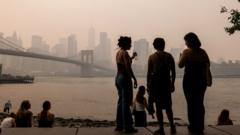
A thick blanket of smoke clouded skylines from Detroit and Toronto to New York and across New England, causing "hazardous" air quality alerts across much of the region. Many outdoor events were cancelled as officials urged for people to stay indoors, stressing the dangerous health ramifications of inhaling the fumes.
In Canada, one fire in northern Ontario forced residents from local First Nations to evacuate, with one chief saying that her community has been "burnt to ashes". Many outdoor activities were cancelled on Thursday, including events for children's summer camps, and beaches were shuttered along popular lakes.
An outdoor concert for the rock group The Black Keys was being rescheduled in Chicago due to the dangerous air quality. There are currently 858 fires actively burning in Canada, including 30 new fires that sparked on Thursday, according to the Canadian Wildland Fire Information System.
The vast majority are burning out of control.
The large cluster of fires affecting northwestern areas of Ontario are responsible for sending thick plumes of smoke and poor air quality across Thunder Bay and Toronto, with lower concentrations of smoke high in the atmosphere drifting over the Great Lakes and above New York with hazy skies.
The far-reaching impacts of wildfire smoke – and how to protect yourself "We're in a very serious health situation right now," New York Governor Kathy Hochul said in an announcement on Thursday. She noted thick smoke was "blanketing" much of the state, making it "very unhealthy to be outdoors" in many areas.
"This is bad news for every New Yorker," she said. "There will be great impacts." A thick haze of smoke blocked views across the city of sights including the Empire State Building and the Statue of Liberty.
New York has extended its heat emergency plans and activated its air quality emergency protocols - with hundreds of cooling centres and KN95 masks being made available citywide. In Ontario, there will be quite widespread thunderstorms over the next few days, but the rain may not be enough to make much of a difference.
Air quality in the Midwestern city of Detroit is currently the worst in the world, Swiss air quality tracker IQAir said, followed by Minneapolis, Chicago and Toronto.
Republican lawmakers in the state of Michigan have penned an open letter , external to Canadian Prime Minister Mark Carney asking for better management of the country's wildfires, expressing frustration for a third year in a row.
"A year has passed, the season has come around again, and nothing has changed except that our patience has run out," said the letter, signed by four state House representatives.
Wildfires are a part of the natural life cycle of Canada's vast boreal forest, but they have become more frequent since 2015, said Laura Chasmer, a professor of geography and the environment at the University of Western Ontario.
"This is associated with some of the extreme climate warming that we've been seeing, and the atmospheric drying of the surface," she said.
Fires in the past burned more frequently in western Canada, but recent years have seen that trend migrate eastward, with large fires now burning in Ontario, Quebec and Atlantic provinces, Chasmer said, leading to more noticeable smoke in densely populated cities like Toronto and New York.
She added that this has strained firefighting efforts in Canada, whose primary focus is to ensure the flames don't spread to nearby towns. Putting out the fires completely is "very difficult", Chasmer noted, due to their scope and intensity.
He added his government is "in close communication" with provinces and local communities. Meanwhile, Ontario Premier Doug Ford dismissed criticism of his government's handling of the fires, noting that over 150 fire crews are on the ground battling the blaze. "We will spend whatever it takes," Ford said.
In addition to the hazardous smoke, the wildfires in northern Ontario have forced dozens from local First Nations communities to evacuate, with videos showing some fleeing the remote area by boat.
Namaygoosisagagun First Nation Chief Helen Paavola told local news outlet CityNews in an interview that an aerial flyover showed that her community has been "burnt to ashes". "All the homes are gone," she said on Thursday. "There's nothing left."
America's blame game over Canada's wildfire smoke misses the point, experts say