BBC News
Top story
COP30: Trump and many leaders are skipping it, so does the summit still have a point?
The US president is notably absent from these UN climate talks, as are other world leaders, all of which prompts questions about the purpose of COP today.
There is a photograph, taken ten years ago in Paris, that today seems like something of a relic. In it, dozens of men and women line up in dark suits, in front of an enormous sign that reads COP21 Paris. What a far cry from the family photograph taken on Thursday with this year's line-up at the COP30 summit in Brazil.
In fact, the Trump administration has exited the process entirely and has said it will not send any high-level officials this year. Which raises the question, why have a two-week-long multinational gathering at all if so many leaders aren’t there?
Christiana Figueres, the former head of the UN's climate process under whose leadership the Paris Agreement was struck, said during last year's gathering that the COP process was "not fit for purpose."
"The golden era for multilateral diplomacy is over," agrees Joss Garman, a former climate activist who now heads a new think tank called Loom. "Climate politics is now more than ever about who captures and controls the economic benefits of new energy industries," he tells me.
So, with carbon dioxide emissions still rising even after 29 of these meetings - which are, after all, aimed at bringing them down - will more COPs make any difference? "This 'climate change' - it's the greatest con job ever perpetrated on the world," he told the UN General Assembly in September.
"If you don't get away from this green scam, your country is going to fail." He has rolled back restrictions on oil, gas, and coal, signed billions of dollars of tax breaks for fossil fuel firms, and opened up federal lands for extraction.
Meanwhile, he has set about dismantling his predecessor Joe Biden's clean energy agenda. Subsidies and tax breaks for wind and solar have been slashed, permits withdrawn, projects cancelled. Research funding has been cut too. John Podesta, a senior adviser on climate to both Obama and Biden, sees it differently.
"The United States is taking a wrecking ball to clean energy," he argues. Anna Aberg, a Research Fellow in Chatham House's Environment and Society Centre, describes COP as "taking place in a really difficult political context" given Trump's position.
"I think it's more important than ever that this COP sends some kind of signal to the world that there are still governments and businesses and institutions that are acting on climate change. ” In 2023, clean technologies drove roughly 40% of China's economic growth, according to the climate website Carbon Brief.
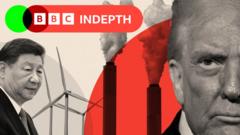
After a slight slowdown last year, renewables accounted for a quarter of all new growth and now make up more than 10% of the entire economy. And, like Trump's America, China is engaging internationally well beyond participation in COP - it is taking its entire energy model global.
The split has transformed the climate debate. It is now one that pits the world's two superpowers against each other for control of the most essential industry on Earth.
Speaking at this year‘s conference, a source in government at a major developed country said: “Of all the things they're most terrified of, the biggest is being seen to criticise Trump.
” The President of the European Commission, Ursula von der Leyen, warned last month that Europe must not repeat what she termed the mistakes of the past and lose another strategic industry to China.
She called the loss of Europe's solar manufacturing base to cheaper Chinese rivals "a cautionary tale we must not forget". The European Commission has forecasted that the market for renewables and other clean energy sources will grow from €600bn (£528bn) to €2 trillion (£1.
74tn) within a decade and wants Europe to capture at least 15% of that. But that ambition may come too late. "China is already the world's clean-tech superpower," says Li Shuo, director of the China Climate Hub at the Asia Policy Institute.
Its dominance in solar, wind, EVs, and advanced battery technologies, he says, is now "virtually unassailable”. He likens it to trying to beat the Chinese national team at table tennis: "If you want to surpass China, you had to get your act together 25 years ago. If you want to do it now, you have no hope."
China produces over 80% of the world's solar panels, a similar share of advanced batteries, 70% of EVs, and more than 60% of wind turbines - all at phenomenally low prices. The EU's recent move to raise tariffs on Chinese EVs reflects the scale of the dilemma.
Open the market and Europe's car industry could collapse; close it and green targets may not be met.
Restricting Chinese access to these markets may slow emissions reductions, says Joss Garman, but he argues, "If we ignore questions about economic security, jobs, national security, that risks undermining public and political support for the entire climate effort."
Now, with these shifts in direction of global politics and priorities, Anna Aberg says she expects COP to become an annual forum for "holding to account" countries and other organisations, something she believes remains an "important role”.
The gathering in Brazil follows the acknowledgement by UN Secretary-General António Guterres that the 1. 5°C target set in Paris will be breached - this, he has said, represents "deadly negligence" on the part of the world community.
Last year was the hottest ever recorded, and 60 leading climate scientists said in June that the Earth could breach 1. 5°C in as little as three years at current levels of carbon dioxide emissions. Yet more people are questioning the need for an annual gathering. "I think we need one big COP every five years.
And between that, I'm not sure what COP is for," says Michael Liebreich, founder of energy consultancy Bloomberg New Energy Finance and host of a green energy podcast, Cleaning Up. "You can't just expect politicians to go and make more and more commitments.
You need time for industries to develop and for things to happen. You need the real economy to catch up." He believes it would be much more productive for the discussions to happen in smaller meetings focused on removing barriers to clean energy.
But he also believes that some issues, like implementation, need to be discussed in places he deems more relevant - like on Wall Street "where people can actually fund stuff” - as opposed to on the edge of the Brazilian rainforest. Even so, this will be important negotiations at this year's COP.
Among other things, it aims to get an agreement for a multi-billion-dollar fund to support the world's rainforests like the Amazon and the Congo Basin.
Michael Jacobs, who advised Gordon Brown on climate policy and is now a politics professor at Sheffield University, believes that continued collective support for the process is crucial.
"It's a big political message, because Donald Trump is trying to undermine the collective process, but it's also a message to businesses that they should continue to invest in decarbonisation because governments will continue to enact climate policies."
"It's dry, it's complicated, it's anguished, it's tiring,” he says - “and it's absolutely necessary”. Many now do, however, accept there is a strong argument for these international gatherings to be scaled down.
Ultimately, however, the real choice underlying it, for so many nations in attendance, simply comes down to the extent to which they align with a China-led clean energy revolution - or double down on the fossil fuels–first agenda.
Which is why many observers say the process of decarbonisation is going to be less about the multi-country commitments of COPs past, and far more about big-money deals between individual countries as we look ahead to this year’s summit - and how COPs may well play out in the future.