BBC News
Top story
What China critics in Maga movement make of Trump's Beijing trip
Trump’s softer approach towards China is one that experts say will likely trickle down to the wider MAGA base.
When Donald Trump strode on to a stage at a campaign rally in Indiana in 2016, he made one thing clear: China was America's chief economic antagonist. "We can't continue to allow China to rape our country," he told a crowd in Fort Wayne. "We have the cards. Don't forget it."
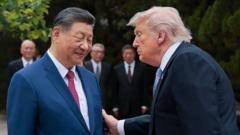
The anti-China rhetoric didn't let up - through a decade of rallies, his 2024 campaign and into his second term. Then came this week's visit to Beijing. Trump stepped on to a red carpet at the Great Hall of the People to hundreds of flag-waving children and a military band belting out the Star-Spangled Banner.
Trump soon hailed "fantastic trade deals", although no major breakthrough was confirmed. Chipmaker Nvidia was reportedly given a go-ahead to sell semiconductors to 10 Chinese companies and Boeing secured an order for 200 aircraft. Citi was granted an approval to operate a securities business in China.
But amid the pleasantries and softened positions, hardline positions against China reflect the traditionally more hawkish stance of Trump's Republican Party. And outstanding issues remain - chiefly Taiwan, the self-ruled island viewed by Beijing as a renegade province.
Trump delivered few details on the fate of a delayed $14bn arms sale viewed as essential by Democrats and Republican China "hawks" alike. Ahead of the visit, a bipartisan group of senators sent a letter urging Trump to move ahead with the sale and "formally" notify his Chinese counterpart.
"On Taiwan, he [Xi] feels very strongly. I made no commitment either way," Trump told reporters on Air Force One, adding that he would make a "determination over the next fairly short period" about the arms sale.
Notably, the Chinese read-out of the meeting made Taiwan its central point, arguing that a failure to address the issue could lead to "clashes and even conflicts, putting the entire relationship in great jeopardy". The White House read-out made no mention of Taiwan.
The Chinese statement was seen as a threat by some within the broader Make America Great Again movement. "I am shocked, given how much people wanted to make this into a positive spirit, he [Xi] started with a threat," former Trump strategist Steve Bannon told Politico.
"It was so brazen and so blatant, that they made this at the very top." However, even the most ardent China hawks on Capitol Hill and among Trump's allies stayed largely silent after the trip, offering little reaction to Trump's friendly tone and non-committal statements on Taiwan.
"That doesn't mean it's not going to be a successful summit," he added. Trump's softening rhetoric and tone, Firestein added, could reflect an acknowledgement that the tactics used in the years after his last visit in 2017 have not worked.
"We still have the same problems today with market access, intellectual property rights, subsidies…the list goes on," he said. "None of those problems have been solved after eight years of having these tariffs on the books."
David Sacks, a fellow for Asia studies at the Council on Foreign Relations, said that the softening of Trump's tone will likely trickle down to other officials, Republican lawmakers and Trump's wider base. "When Trump opines, people follow," he said. "And the base follows."
Trump, however, still faces a dilemma with Taiwan. Pressure will remain - from both sides of the political spectrum - for Trump to formalise the pending $14bn weapons sale ahead of President Xi's planned visit to the White House in September.
"I think that Congress will continue to write letters urging the administration to approve the sales to Taiwan," Sacks said. Until then, he continued, each time "senior administration officials go before Congress they will continue to be asked about the status of those arms sales to Taiwan".
A decision from the Oval Office, however, is by no means guaranteed.